The "ATS Score" is a Lie (An Interviewer's Perspective)
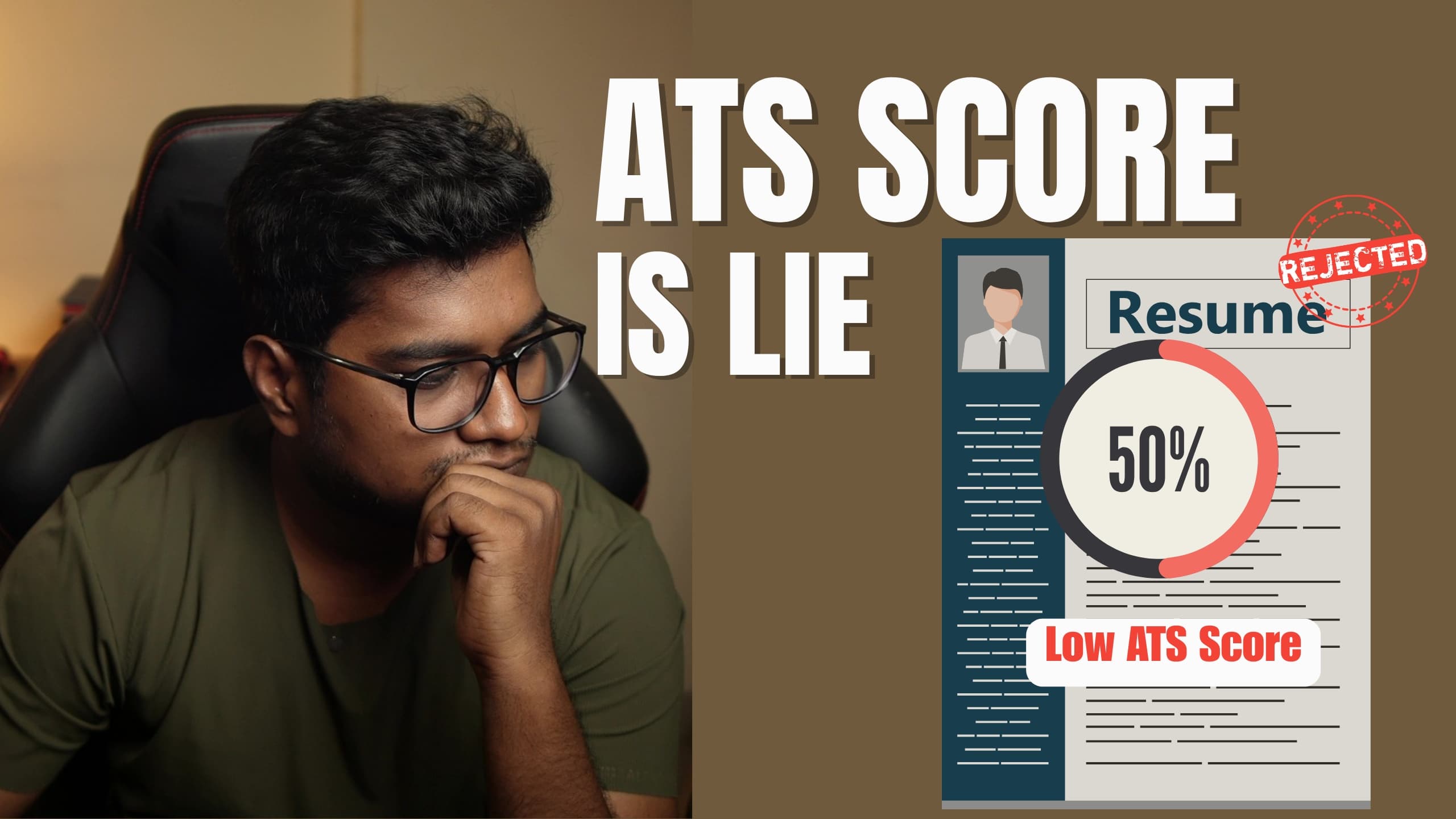
If you've applied for tech jobs recently, you've probably uploaded your resume to a website that gave you an "ATS Score." It probably told you your score was terribly low — but surprise, surprise — if you pay for their premium service, they'll magically help you make your resume "ATS compliant."
Most of that scoring system is a blatant lie designed to sell you a product.
I'm Rahul Bharati, a Senior Software Engineer, and for almost two years now I've been a certified technical interviewer at EPAM. I've evaluated close to 200 candidates and personally interviewed over 150 of them. Below is the reference sheet for the video above — the key facts, the traps, and a three-step action plan you can use before your next application.
What the ATS Actually Is
The ATS is built for job seekers. A high ATS Score means your resume is strong and competitive across all jobs.
The ATS is B2B software built for organizations. It checks your resume against one specific JD and generates an internal match percentage. There is no universal score.
When people talk about an "ATS Score" they think it's a universal grade of how good their resume is. In reality, it's just a threshold. Companies configure weighted keywords from the JD. The system checks your resume against that specific JD and flags a match percentage internally.
Your resume is mapped strictly to the job — not to a universal template. A 90% score on one JD could be 10% on another with the exact same resume.
The Tech Stuffing Trap
You know exactly what this looks like: the massive block at the bottom of a resume with 30 different languages, frameworks, and cloud providers separated by commas. People think casting a wide net will inflate their ATS score.
But the ATS only cares about the JD. If you list AWS, Azure, GCP, Rust, and C++ for a React developer role, those are unmapped skills — the parser assigns zero weight to them.
Tech stuffing is dangerous in the interview room. If you pass the ATS and your resume lands on my desk, every word on that paper is fair game. If you listed Docker because you spun up a container once following a tutorial three years ago, I will ask you about container orchestration, networking, and image optimisation. When you stumble, you don't just fail that question — you lose your technical credibility for the entire interview.
Do not list a skill unless you are ready to defend it on a whiteboard.
Why Fancy Resume Templates Fail
I learned this the hard way. Early in my career I built a colorful Canva resume. A connection refused to refer me with it, warning it wouldn't survive the ATS. I rebuilt it in FlowCV — it looked great.
But cracks appeared immediately. Every time I uploaded that PDF to Workday or Greenhouse, the timelines were scrambled, experience boxes had the wrong dates, and skills were mapped incorrectly. I had no idea why, so I manually corrected every field every single time, chasing this mythical ATS Score.
It wasn't until I sat on the interviewer's side that the illusion shattered.
What I actually see as an interviewer: Your parsed resume with JD keywords highlighted — either as a digital overlay on your PDF, or a parsed profile card where terms like "JS", "Redux", and "Optimization" are practically glowing on screen. No score. No star rating. Just highlighted keywords and your work history.
The creators selling you "ATS templates" have never seen the interviewer's dashboard. They've never seen the overlay. They are guessing.
Multi-column layouts, text boxes, and creative formatting confuse the text extraction layer. Your dates get scrambled. Your skills get orphaned from context. The highlighted overlay shows garbage — and that's the first thing I see.
How to Actually Beat the ATS
Stop optimizing for a score that doesn't exist on my screen. Do this instead:
Find the exact keywords they use. If they write TypeScript, write TypeScript — not "TS". If they list React, add it. Add only what you can defend in a live technical conversation.
Build your resume in Google Docs or Word. Single column. Clean sections. Export as a standard PDF. The parser reads raw text — not visual design. The simpler the layout, the more reliably your keywords land.
Upload your PDF to Gemini or ChatGPT. Use these two prompts back-to-back:
Prompt 1 — parse check:
"Here is my resume. Can you clearly read my career timeline,
job titles, dates, and listed skills? What do you see?"Prompt 2 — JD alignment:
"Here is the job description I'm targeting. Compare the keywords
in this JD against my resume. What am I missing? Only suggest
additions based on skills I already have."Focus strictly on JD alignment. Stop optimising for the robot — start optimising for the human on the other side of the screen.
What's Next
Getting past the ATS is just the beginning. The real test is the human on the other side of the screen — and most candidates are not ready for it. I'll be breaking down the most fatal technical interview mistakes in the next video, drawn directly from 150+ live sessions.
Subscribe on YouTube so you don't miss it.